

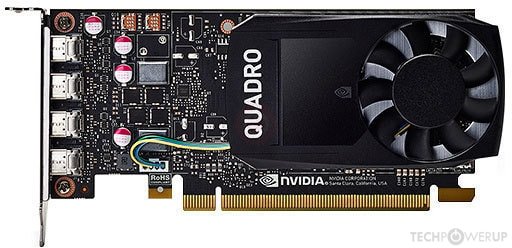

NVIDIA QUADRO P1000 4 GB GDDR5 128 bit
Key Features & Highlights:
-
Memory & Bandwidth: 4 GB GDDR5 memory, 128-bit interface, ~ 80 GB/s bandwidth.
-
CUDA Cores: 640 cores enabling strong GPU compute performance for professional tasks.
-
Boosted Clock Speeds: Base and boost clocks around 1266-1480 MHz (varies by variant) for good single-precision throughput.
-
Compact & Efficient Design: Single-slot, low-profile form factor; requires ~ 47 W power. No extra power connectors needed in many systems.
-
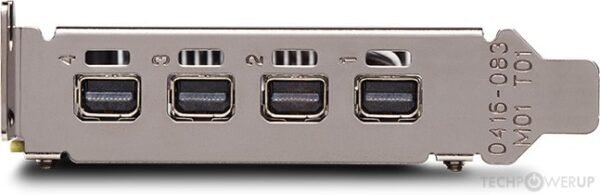
Display Support: 4 × mini-DisplayPort 1.4 outputs; support for up to four 4K displays (4096×2160 @ 60Hz) or 5K via DisplayPort MST.
-
API Compatibility: Supports DirectX 12, OpenGL 4.5, Vulkan 1.0; certified drivers for professional apps.
Key Features & Highlights:
-
Memory & Bandwidth: 4 GB GDDR5 memory, 128-bit interface, ~ 80 GB/s bandwidth.
-
CUDA Cores: 640 cores enabling strong GPU compute performance for professional tasks.
-
Boosted Clock Speeds: Base and boost clocks around 1266-1480 MHz (varies by variant) for good single-precision throughput.
-
Compact & Efficient Design: Single-slot, low-profile form factor; requires ~ 47 W power. No extra power connectors needed in many systems.
-
Display Support: 4 × mini-DisplayPort 1.4 outputs; support for up to four 4K displays (4096×2160 @ 60Hz) or 5K via DisplayPort MST.
-
API Compatibility: Supports DirectX 12, OpenGL 4.5, Vulkan 1.0; certified drivers for professional apps.
Strengths / Best Use Cases:
-
Ideal for professional workstation environments where multiple displays are needed.
-
Great for CAD, technical visualization, 2D/3D content creation with moderate complexity.
-
Useful when space, power consumption, and quiet operation are important (e.g. small form-factor workstations).
-
Reliable driver support in professional software suites ensures stability and compatibility.
Limitations & Considerations:
-
While 4 GB VRAM is decent, very large 3D models, very high resolution textures, or heavy rendering tasks may stretch its capabilities.
-
Not designed as a high-end gaming GPU — gaming performance will lag behind similarly priced consumer graphics cards.
-
Being Pascal generation (2017), lacks newer features like dedicated ray-tracing cores or more current video codec enhancements found in newer architectures.
Reviews
There are no reviews yet.