

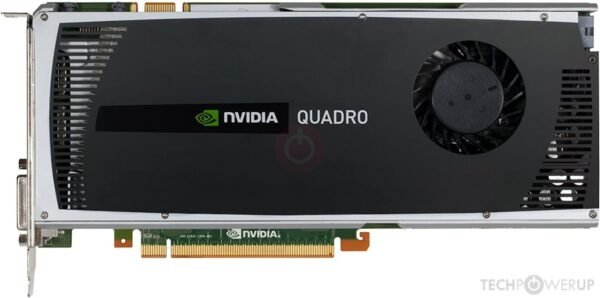

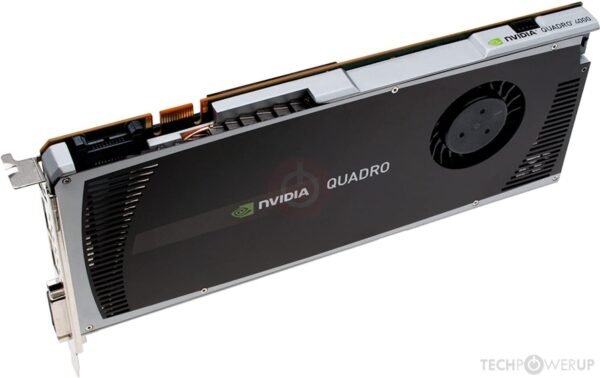
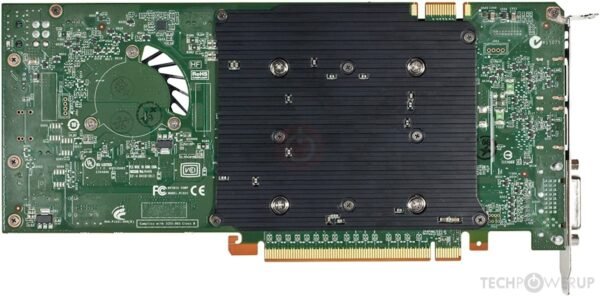
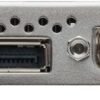
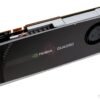
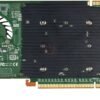
NVIDIA QUADRO 4000 2 GB GDDR5 256 bit
Key Specifications — NVIDIA Quadro 4000
| Feature | Detail |
|---|---|
| Architecture | Fermi (based on the GF100 GPU) |
| CUDA / Shader Cores | 256 shading units / CUDA cores |
| Memory | 2 GB GDDR5 |
| Memory Interface / Bus Width | 256-bit |
| Memory Bandwidth | ~ 89.6 GB/s |
| Interface / Bus | PCI Express 2.0 ×16 |
| Display Outputs | 1 × DVI-I, 2 × DisplayPort |
| Form Factor | Single-slot card, full height; approx. 9.50″ length by ~4.38″ height |
| Power Consumption (TDP) | ~142 W |
| Display Support / Resolutions | Digital: up to ~ 2560×1600 @ 60Hz (via DisplayPort / DVI-DL) depending on connector; analog via conversions possible |
Key Specifications — NVIDIA Quadro 4000
| Feature | Detail |
|---|---|
| Architecture | Fermi (based on the GF100 GPU) |
| CUDA / Shader Cores | 256 shading units / CUDA cores |
| Memory | 2 GB GDDR5 |
| Memory Interface / Bus Width | 256-bit |
| Memory Bandwidth | ~ 89.6 GB/s |
| Interface / Bus | PCI Express 2.0 ×16 |
| Display Outputs | 1 × DVI-I, 2 × DisplayPort |
| Form Factor | Single-slot card, full height; approx. 9.50″ length by ~4.38″ height |
| Power Consumption (TDP) | ~142 W |
| Display Support / Resolutions | Digital: up to ~ 2560×1600 @ 60Hz (via DisplayPort / DVI-DL) depending on connector; analog via conversions possible |
🔍 Features / Highlights
-
Built for professional workstation workloads: CAD, 3D modelling, scientific visualization.
-
Supports hardware tessellation, scalable geometry engine, good double-precision capability for certain compute applications.
-
Efficient display options with multiple high-res digital outputs. Strong for multi-monitor setups.
⚠️ Limitations / Considerations
-
VRAM is only 2 GB, which is low for modern large 3D models / very high resolution workflows.
-
Power draw of ~142 W means you need a strong enough PSU and case cooling.
-
Based on older Fermi architecture — lacks modern features like newer video codec acceleration, current generation ray tracing, tensor cores, etc.
-
PCIe 2.0 interface; newer cards use PCIe 3.0/4.0/5.0 which offer more bandwidth.
Reviews
There are no reviews yet.