

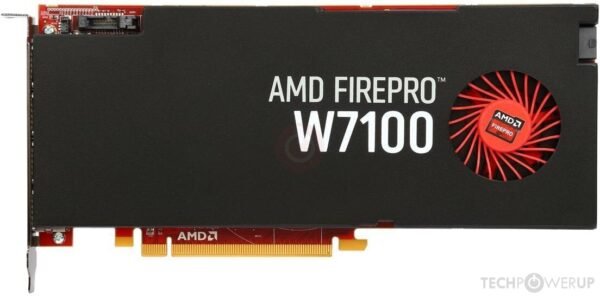

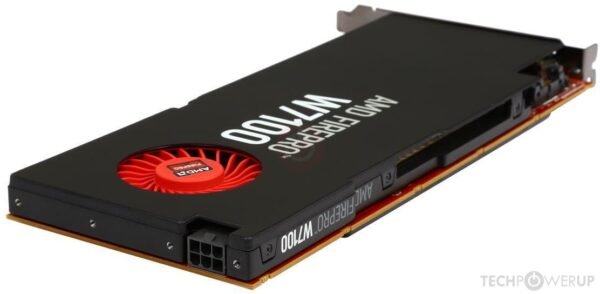
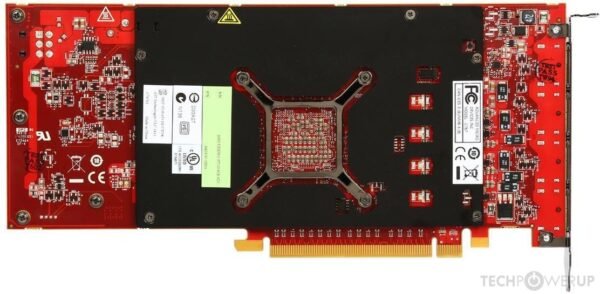
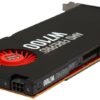
AMD FIREPRO W7100 8 GB GDDR5 256 BIT
Specifications:
| Spec | Detail |
|---|---|
| GPU Architecture | GCN 3.0 «Tonga PRO GL» |
| Process Node | 28-nm |
| Stream / Shader Processors | 1,792 (28 compute units) |
| Memory | 8 GB GDDR5 |
| Memory Bus Width | 256 bits |
| Memory Bandwidth | ~ 160 GB/s |
| Core Clock | ~ 920 MHz |
| PCI Interface | PCI Express 3.0 ×16 |
| Power Connector / Consumption | ~ 150 W max, needs a 6-pin power connector |
| Dimensions / Cooling | Single-slot form factor (though full-length) with active cooling (has a fan) |
| Display Outputs | 4 × DisplayPort 1.2 (supports up to four 4K displays) |
| Max Resolution per Output | 4096 × 2160 @ 60 Hz via DisplayPort 1.2 |
Specifications:
| Spec | Detail |
|---|---|
| GPU Architecture | GCN 3.0 «Tonga PRO GL» |
| Process Node | 28-nm |
| Stream / Shader Processors | 1,792 (28 compute units) |
| Memory | 8 GB GDDR5 |
| Memory Bus Width | 256 bits |
| Memory Bandwidth | ~ 160 GB/s |
| Core Clock | ~ 920 MHz |
| PCI Interface | PCI Express 3.0 ×16 |
| Power Connector / Consumption | ~ 150 W max, needs a 6-pin power connector |
| Dimensions / Cooling | Single-slot form factor (though full-length) with active cooling (has a fan) |
| Display Outputs | 4 × DisplayPort 1.2 (supports up to four 4K displays) |
| Max Resolution per Output | 4096 × 2160 @ 60 Hz via Display Port 1.2 |
Strengths:
-
Large Memory Buffer: 8 GB of VRAM helps with large datasets, complex 3D models, high texture usage, or large resolution displays.
-
Workstation / Professional Features: Designed for GPU compute, CAD/CAM/CAE, 3D modelling, video editing, and other pro use cases. Drivers and stability more refined for those tasks than consumer-gaming cards.
-
Multi-display Support: Supports 4 DisplayPorts, good for multiple monitors at 4K, which is useful for engineering / design work. Eyefinity etc.
-
Single Slot: Even though it’s full-length, it being single-slot is helpful in cramped workstation cases or multi-GPU setups with limited space.
Limitations:
-
Older Architecture / Outdated Process Node: 28-nm is old compared to modern GPUs (which are on 7nm, 5nm, etc.), so efficiency, power draw, and generational performance lag behind newer cards.
-
Gaming Performance: Even though it has decent hardware, it’s not optimized for gaming. Lower clocks than consumer gaming GPUs, and professional drivers may constrain performance in games.
-
Power & Cooling: It still draws ~150 W, and though single-slot, it likely gets warm under load; good airflow and PSU needed.
-
Driver Support / Feature Lags: For cutting edge features (e.g. ray tracing, latest game-optimizations, AI features), modern consumer or enterprise cards will do much better.
Reviews
There are no reviews yet.