

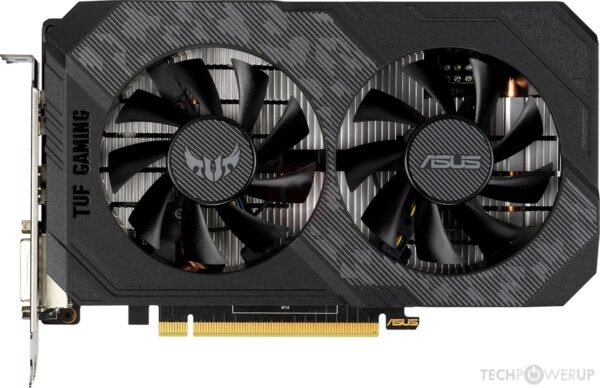
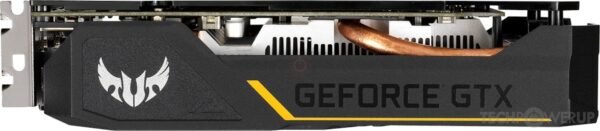
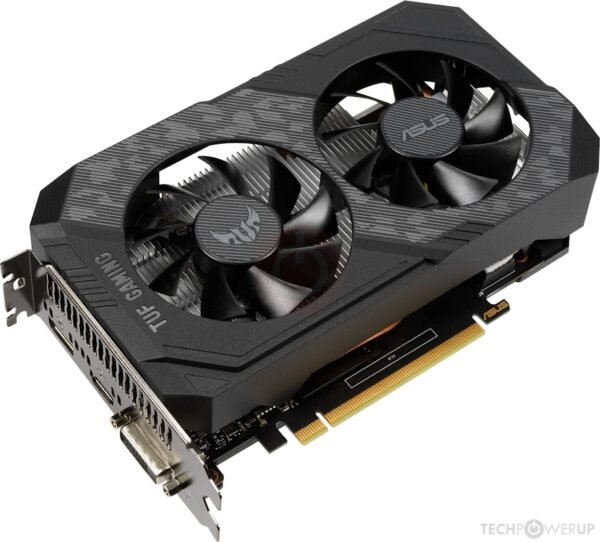
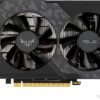


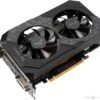
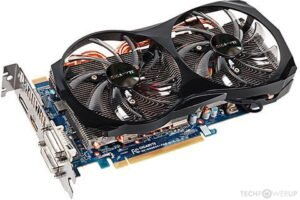
ASUS TUF GTX 1650 GAMING 4 GB GDDR6 128 bit
Key Specifications:
| Spec | Detail |
|---|---|
| GPU Architecture | NVIDIA Turing (TU117) |
| CUDA / Shading Units | 896 |
| Memory | 4 GB GDDR6 |
| Memory Bus Width | 128-bit |
| Memory Speed | 12 Gbps effective |
| Base / Boost Clock | Gaming Mode ~ 1410 MHz base / ~ 1590-1620 MHz boost; OC Mode ~ 1620 MHz boost in some versions |
| Bandwidth | ~ 192 GB/s |
| Power Requirement | ~ 75 W TDP; requires about a 300 W PSU system recommendation; some versions need a 6-pin connector; others are powered entirely via PCIe slot depending on variant. |
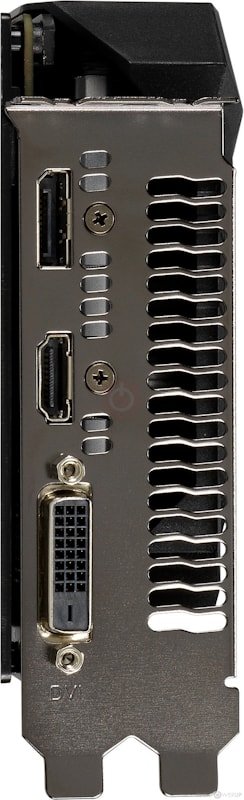
| Display Outputs | DVI-D, HDMI 2.0b, DisplayPort 1.4; supports up to 3 displays |
| Max Digital Resolution | Up to 7680 × 4320 |
| Form Factor / Dimensions | Dual-slot, ~ 20.45 × 12.49 × 4.56 cm (≈ 8.05 × 4.91 × 1.79 in) |
Key Specifications:
| Spec | Detail |
|---|---|
| GPU Architecture | NVIDIA Turing (TU117) |
| CUDA / Shading Units | 896 |
| Memory | 4 GB GDDR6 |
| Memory Bus Width | 128-bit |
| Memory Speed | 12 Gbps effective |
| Base / Boost Clock | Gaming Mode ~ 1410 MHz base / ~ 1590-1620 MHz boost; OC Mode ~ 1620 MHz boost in some versions |
| Bandwidth | ~ 192 GB/s |
| Power Requirement | ~ 75 W TDP; requires about a 300 W PSU system recommendation; some versions need a 6-pin connector; others are powered entirely via PCIe slot depending on variant. |
| Display Outputs | DVI-D, HDMI 2.0b, DisplayPort 1.4; supports up to 3 displays |
| Max Digital Resolution | Up to 7680 × 4320 |
| Form Factor / Dimensions | Dual-slot, ~ 20.45 × 12.49 × 4.56 cm (≈ 8.05 × 4.91 × 1.79 in) |
Strengths & Best Use Cases
-
Solid 1080p gaming performance — will handle most modern games at medium-high settings smoothly.
-
Good for eSports titles where high frame rates are required.
-
Efficient and relatively low power draw compared to more demanding GPUs.
-
Modern features: GDDR6 memory, up-to-date display output types (HDMI, DisplayPort).
-
Robust build (TUF line) usually means good cooling, durability (often includes dust-resistance, etc.).
Limitations & Things to Be Aware Of
-
4 GB VRAM is adequate but may become a bottleneck in games that push large textures or at higher resolutions/settings.
-
Not suitable for heavy workloads like 4K gaming, advanced ray tracing, or ultra settings in the very newest titles.
-
Performance depends on CPU, RAM, and cooling; will not reach peak performance if other parts are weak.
-
Variants may differ (OC mode vs stock); make sure the specific model you have matches the specifications above.
Reviews
There are no reviews yet.